
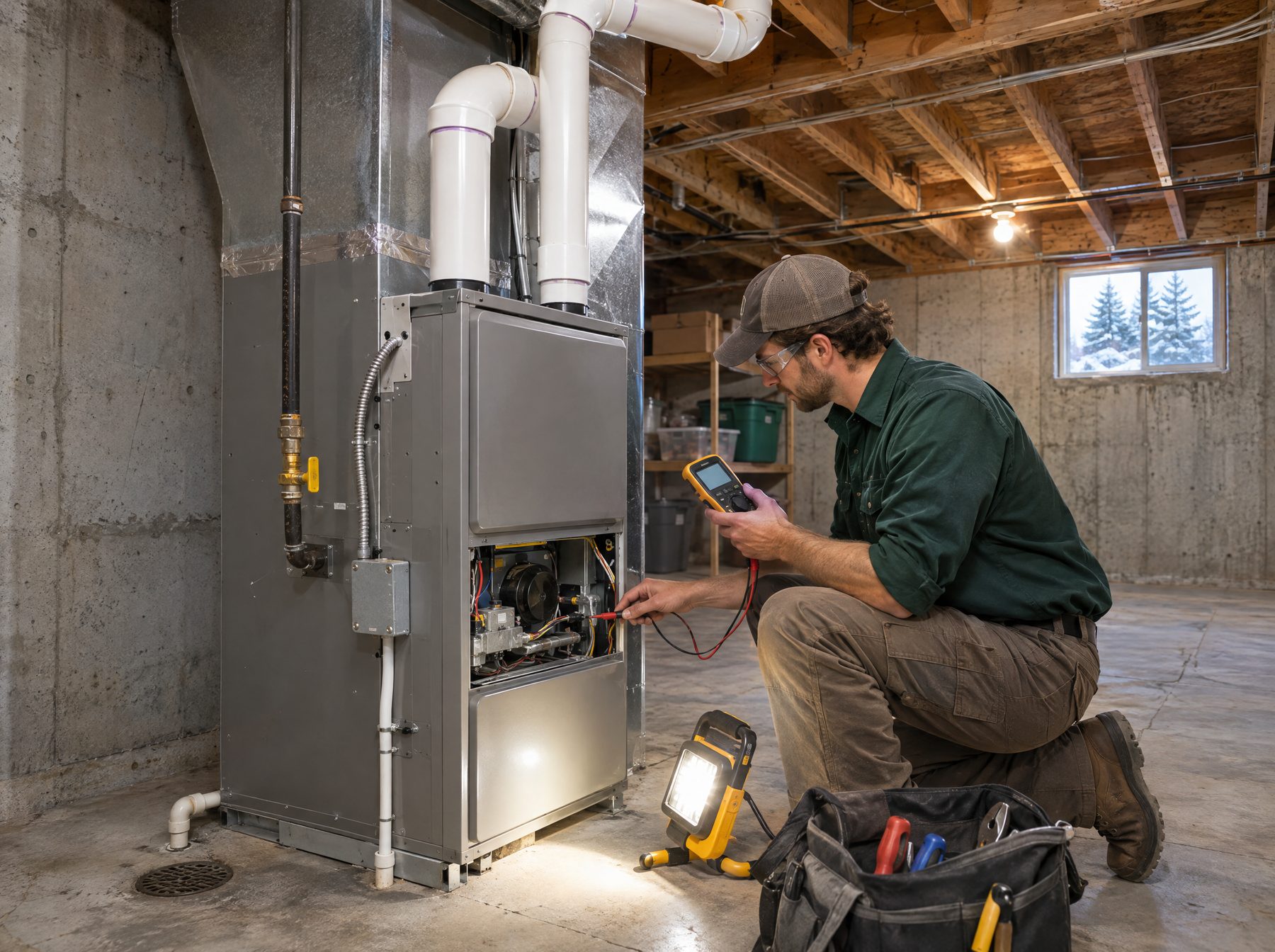
Furnace repair in Spokane
No heat on a January night is the call we treat as the most urgent. Most furnace failures around Spokane come down to a handful of parts: igniters, flame sensors, pressure switches, drains and filters. We find which one, show you, and write the price before we fix it.
- No heat calls answered first
- Cause found and shown before any repair
- Gas work in Spokane under a City gas heating mechanic license
- Written price first
Tell us what the furnace is doing
We usually answer the same day, and within the hour when a house has no heat or no cooling.
No heat or no cooling and someone at home is elderly, unwell or very young? Call or text now: 509-555-0163
No heat? Check these four things first
None of these need tools. If they do not fix it, call or text us. If you smell gas, leave the house and call the gas utility from outside.
Check the thermostat.
Set to heat, set above the room temperature, fresh batteries if it has them.
Check the filter.
A clogged filter can make a furnace overheat and shut down. Smoke season fills them fast.
Check the furnace switch.
A switch near the furnace that looks like a light switch, and the breaker in the panel.
Check the vent pipes outside.
High-efficiency furnaces vent through white pipes on the side wall. Snow and ice can block them.
Common furnace repairs, and what they usually mean
| Repair | What it fixes | What it tells us |
|---|---|---|
| Flame sensor cleaned or replaced | Burners light, then shut off | Common, and often the first thing we check |
| Igniter replaced | No flame at all, the furnace tries and gives up | A wear part; they crack with age |
| Pressure switch or hose | Inducer runs, burners never light | Can also point to a blocked vent or drain |
| Condensate drain cleared | Lockouts on a high-efficiency furnace | The drain carries water out of the furnace |
| Limit switch trips | Burners shut off after running a while | Usually low airflow: a filter, a blower, closed registers |
| Blower motor | Furnace heats but no air comes out | The same blower moves the air for cooling |
What we check on every furnace call
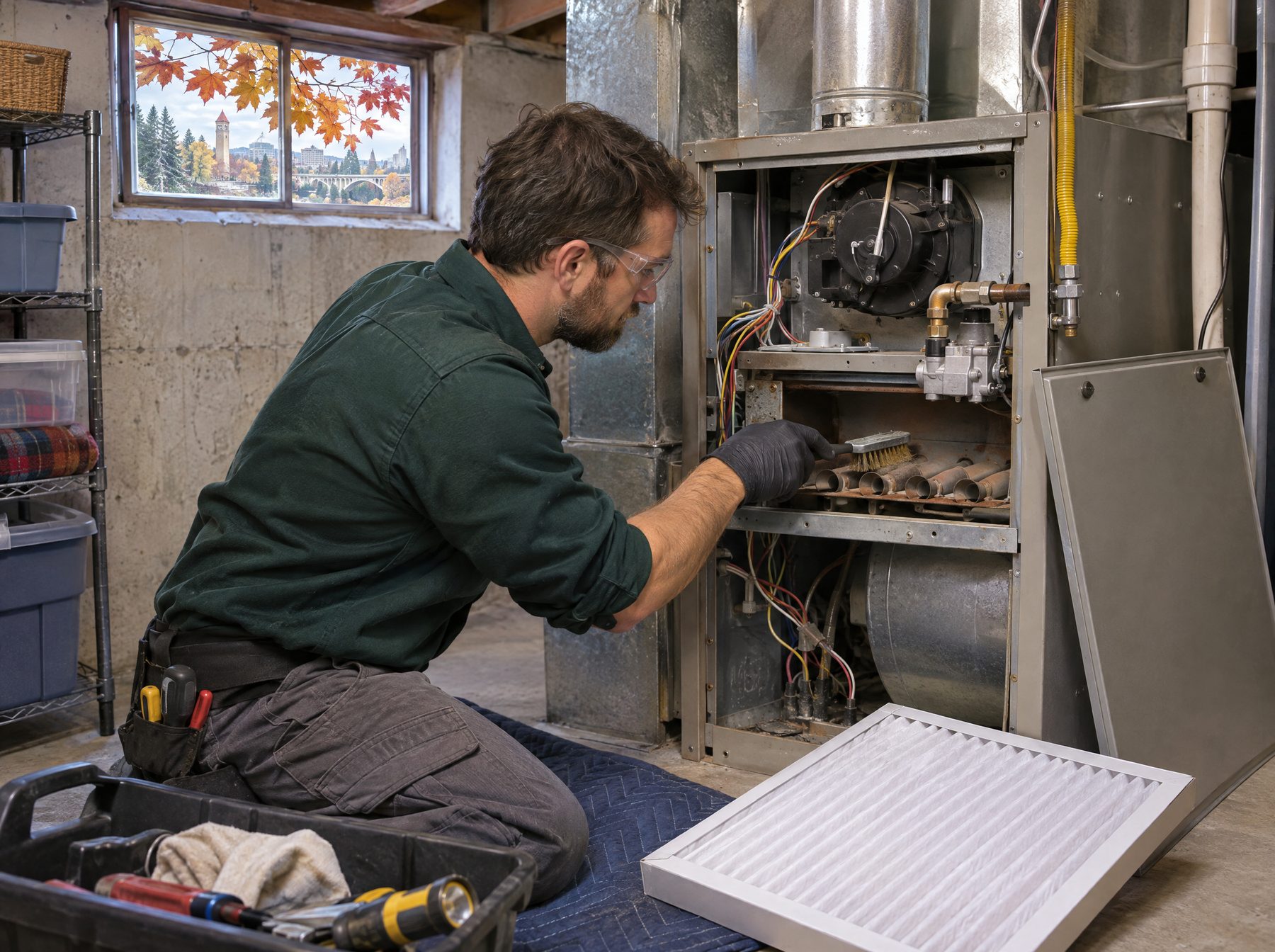
We start with what the furnace is telling us. Most modern furnaces flash a fault code on a small light inside the door, and the code narrows the search. Then we work through the sequence: the call for heat, the inducer fan, the pressure switch, the igniter, the gas valve, the flame sensor, the blower, the limits.
We also check the things that keep it safe: the venting and intake pipes, the drain, the flue connections and the air around the heat exchanger. If something is not safe to run, we tell you plainly and show you why. Every repair is priced in writing before we start.
“No heat on a Sunday night in January, across the state line in Post Falls. Corinne talked me through checking the filter and the switch on the phone, then came out Monday at seven. A cracked igniter. She showed me the old one, gave me the price before she fixed it and was gone by nine.”
The winter a Spokane furnace is there for
From NOAA's 1991 to 2020 normals at Spokane International Airport.
132nights
At or below freezing
Long stretches of steady running
33.7days
That never get above freezing
When a lockout matters most
24.7°F
Normal January low
With a normal January high of 34.5
45.4inches
Normal snowfall a year
Enough to bury a side wall vent
What the signs usually mean
A guide to what we will look at first, not a diagnosis.
Clicks, a glow, then nothing
The igniter is working but the burners are not proving flame. Often the flame sensor.
Runs a few minutes, then stops, over and over
Short cycling. A clogged filter, an oversized furnace, or a thermostat in a bad spot.
Water on the floor by the furnace
A blocked condensate drain or a cracked trap on a high-efficiency furnace.
A heat pump house with cold rooms in a deep freeze
The backup heat may not be switching in. We check the switch point and the furnace together.
The smoke season filter and the winter furnace
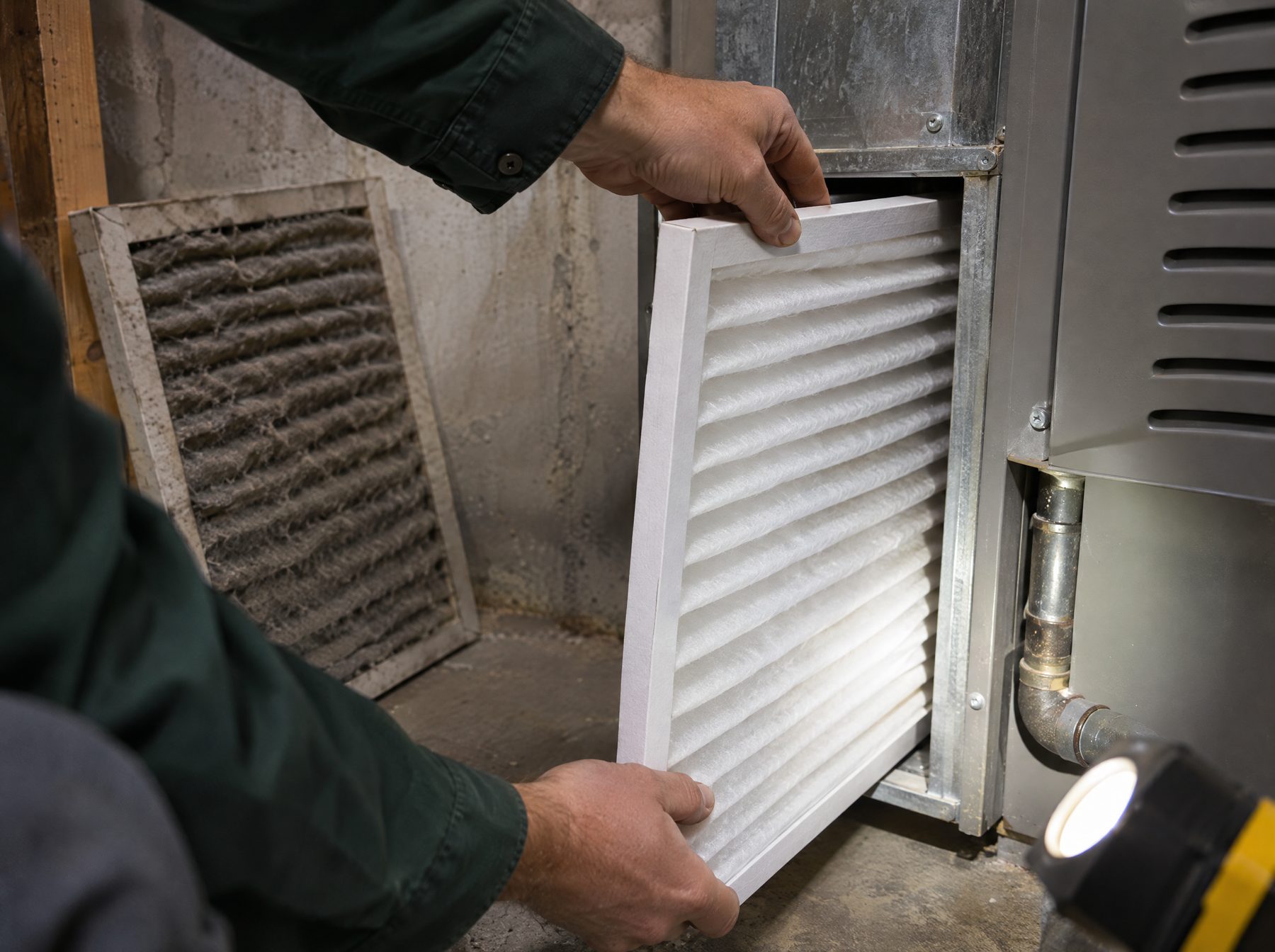
The filter connects the two halves of the year. A good filter catches fine smoke particles in August, and then the same filter sits in the furnace slot into fall. By the first cold week it can be loaded enough to choke the furnace, which overheats and shuts off.
Change the filter after a smoky stretch, not only on the calendar. Avista customers can sign up for its Furnace Filter Reminder Program, or put the change on the fall visit of a maintenance plan. If your filter slot leaves a gap around the filter, we can fit a rack that holds it snug.
Furnace repair around Spokane Valley
We drive out from our office on the Spokane Valley floor. Each town has its own page with the drive, the houses we see there and the office that issues the permit, because that office changes as soon as you cross a city line, and again at the state line.
Spokane
About 10 miles, 14 minutes west. Permits through the City's Development Services Center, and gas work needs a City gas heating mechanic license.
Liberty Lake
About 8 miles, 14 minutes east. The City issues its own mechanical permits, even for a like for like furnace swap.
Mead
About 11.5 miles, 22 minutes north, on the road toward Mount Spokane. Unincorporated, so Spokane County issues the permit.
Cheney and Post Falls
About 26 miles southwest to Cheney, which runs its own building department, and 15 miles east across the line to Post Falls, Idaho.
Furnace repair questions we hear most
Why does my furnace start and then shut off?
The most common cause is a dirty flame sensor: the burners light, the sensor cannot prove the flame, and the furnace shuts the gas off for safety. Other causes are a clogged filter that lets the furnace overheat, a blocked vent or intake pipe, or a pressure switch problem. After a few tries many furnaces lock out and wait.
My furnace has no heat. What should I check first?
The thermostat (set to heat, set above room temperature, batteries), the filter, the furnace power switch (it looks like a light switch near the furnace), and the white vent pipes outside, which can be blocked by snow. If those are fine, call us.
Why does a dirty filter matter so much for a furnace?
A furnace needs air moving across its heat exchanger. A clogged filter starves it of air, it overheats, and a safety switch shuts the burners off. Smoke season loads filters fast, so a filter that went in during July can be packed by fall. See maintenance plans.
Do you need a permit to repair a furnace?
Many repairs do not; replacing a furnace does. It depends on where you live: Spokane Valley and Spokane run their own permit centers, Liberty Lake and Cheney issue their own, and Post Falls in Idaho has its own building division. In Cheney, a no heat repair may start before the permit if it is applied for the next working day. Each town page explains.
Who can work on gas furnaces in Spokane?
In the City of Spokane, mechanical permits for gas lines or gas equipment require a City gas heating mechanic license. We carry that for work inside city limits. Outside the city, the county or town permit office sets its own requirements.
Should I repair my furnace or replace it?
Most repairs are worth doing on a furnace in sound shape. A cracked heat exchanger, a failed control board on an old furnace, or repeated breakdowns are when we talk about replacement, or about adding a heat pump and keeping the furnace as backup. We give you the numbers for both.
Tell us what the furnace is doing
Any fault light or code, what you hear, and whether anyone at home is elderly, unwell or very young. With no heat in winter, call or text for the fastest answer.
Book a furnace repair
We usually answer the same day, and within the hour when a house has no heat or no cooling.
No heat or no cooling and someone at home is elderly, unwell or very young? Call or text now: 509-555-0163